This page details a very expensive example of political dysfunction in South Carolina: the power struggle between the state’s 1975 Home Rule Act and legislators who do not want to relinquish their longstanding control over local governments’ management of funding to improve the state’s dismal transportation infrastructure. Guess who’s winning……
Brief History
Under the 1895 S.C. Constitution, county governments were heavily constrained. Local control was monopolized by individual county legislative delegations, which were primarily composed of local senators and representatives. These delegations acted as the central power, directing granular operational and financial decisions – from purchasing backhoes and hiring sheriff’s deputies, to drafting the local “supply bill”. Local residents had little to no direct control over how their county was governed.
In the late 1960s a push for democratic reform and the need to modernize local governance prompted changes. Following a comprehensive review of the state constitution, voters approved a revised Article VIII at the general election in 1972. This pivotal amendment conferred home rule powers directly to cities and counties and mandated that the General Assembly establish a formalized, standardized structure for local governments. On June 25, 1975, the General Assembly passed and signed into law the Home Rule Act.
Almost immediately, questions regarding some municipal powers emerged, specifically regarding how local governments could handle taxation. What followed was the beginning of the state’s claw-back of powers. The scope of these powers has been shaped by subsequent court decisions which affirmed certain fiscal authorities for municipalities, and the passage of new law (Fiscal Authority Act of 1997) placed more restrictions on local taxation and the overall financial autonomy of cities and counties.
The Home Rule Act had shifted the power to build and maintain roads from appointed state legislative delegations to elected county councils and empowered local governments to independently collect revenues and direct local road spending via County Transportation Committees (CTCs), which continued to receive state gas tax disbursements (known as “C Funds”).
Today’s Reality
“Despite being what is obviously a local matter, CTC membership is often not decided by a county’s local government. Instead, most CTC appointments are made by groups of lawmakers representing each county, called legislative delegations.” – The South Carolina Policy Council
Delegations control appointments in 35 of the state’s 46 counties. Here are the only counties where CTCs are locally controlled by county councils:
- Where the County council serves as CTC: Abbeville, Chester, Clarendon, Jasper, Lexington, and York
- Where the County council appoints CTC: Allendale, Barnwell, Beaufort, Berkeley, Dorchester
While some reforms are coming to the state Department of Transportation (SCDOT) on July 1, 2027, the underlying problem is that legislators, many of whom who do not live within the county of the Delegation of which they are part, have power over the appointments of the CTC members across 75% of the state. While they have no vote in those committees’ decisions, they hold the power of the purse and can wield it to influence members to do their bidding, always at the expense of taxpayers who have no ability to vote those legislators out of office. The crux of the problem is the simple matter of taxation without representation.
Here are two examples of delegations where none of the members live in the county they represent:
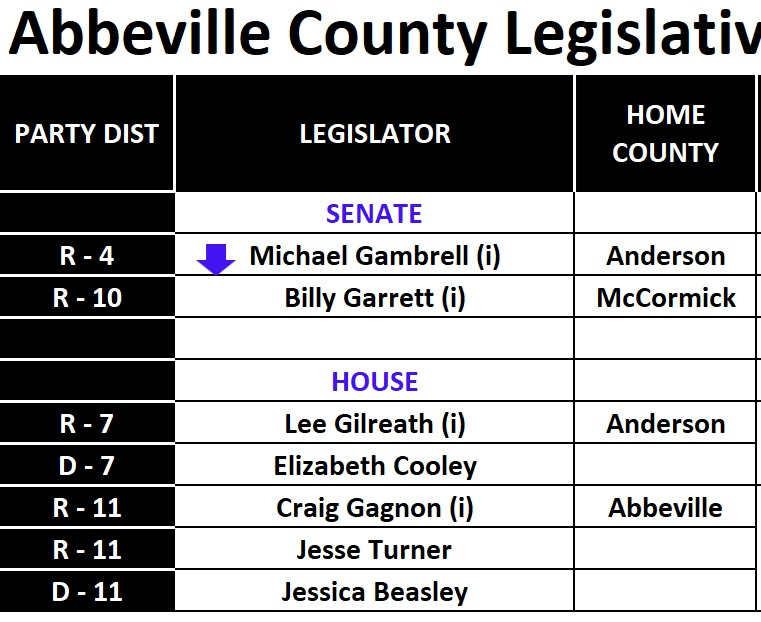
Names without (i), meaning “incumbent,” are primaried candidates for the Nov. 2026 election.
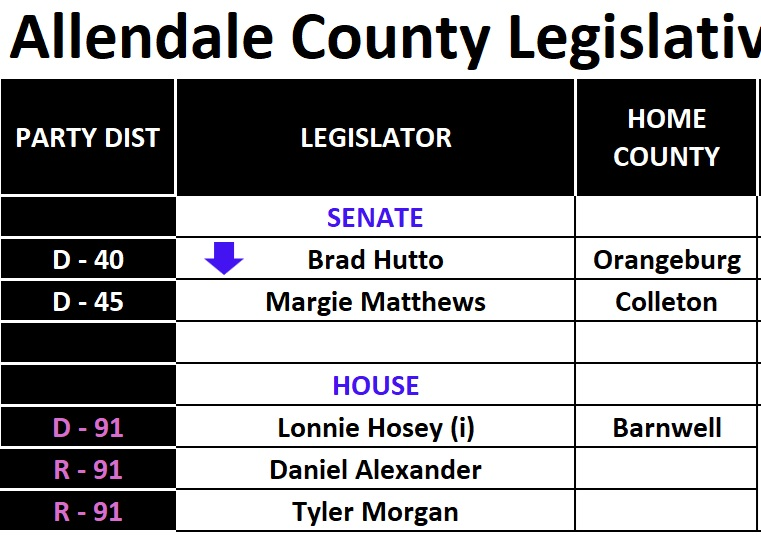
Ready for some homework?
DEEPER DIVE
https://www.scpolicycouncil.org/delegations_in_sc_rank_among_most_powerful_in_nation
https://www.scpolicycouncil.org/reforms_for_results_solutions_for_s_c_s_transportation_challenges